My piece aftur kem ég heim til þín (e. I return home to you) is inspired by the village of Eyrarbakki. My mother’s family is from the village and it is where I lived for the first few months of my life. In 2018 my parents bought a house in Eyrarbakki and now spend most of their time there. I decided to compose a piece about this village, because it was my first home when I was born, and recently has started feeling like home again after my parents moved there. The name of the piece translates to “again I come home to you” or “I return home to you” which is a line from the poem ‘Elskulegi Eyrarbakki’.
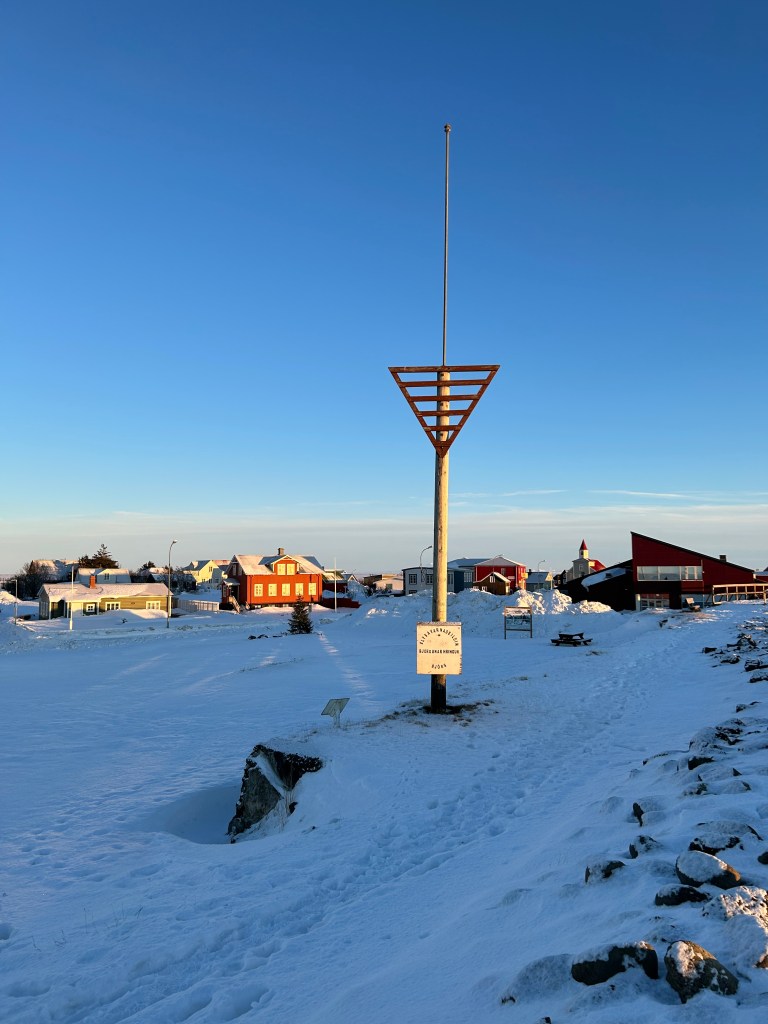
The piece is made with field recordings that I recorded in January 2023 in Eyrarbakki. It was minus 8 degrees Celsius outside, and the ground was covered in snow. The only sound I heard on my walk around my parents’ house was that of the birds, the ocean, and my own footsteps in the snow. I use the recordings I made of those sounds in my piece. While walking around the town with my portable audio recorder I felt this pensive tranquility. The peace and the silence on the streets were a welcome change from the busyness of the city, however, it was also a sad reminder of how village-life has faded in the last 100 years. Even though the population has shrunk, the community still stands strong. It was important to me to include this community in the piece, and I did so by including various recordings of songs that are important to the village.
The first song that I have a recording of is from an annual midwinter festival called Bakkablót. It is the town’s version of Þorrablót, which is a traditional Icelandic festival where participants spend an evening drinking, eating traditional food, and entertaining each other with various songs, poems, and speeches. Every year my grandfather writes a long poem about what has happened in the town that year, and in 2011 his poem was performed by the former local priest, the same priest that christened me. In my piece I have included the first stanza of his poem, in which he sings that living in Eyrarbakki is great but nothing newsworthy ever happens. I include that recording because I too think nothing much happens there, but people still love living there.
The second song I used is ‘Elskulegi Eyrarbakki’ (e. Lovely Eyrarbakki), which is the song to a poem about Eyrarbakki by Garðar Sigurðsson. It is sung at almost every event where the people in Eyrarbakki come together (except perhaps funerals). I have two recordings of the song being sung by the people of the village; one is from the Bakkablót (the same one as the previous recording), and the other is of the Eyrarbakki church choir singing it (recorded by my mother). My mother and three of her sisters are in the choir.
My goal with this piece is to compose a portrait of the landscape of Eyrarbakki. These are some of the aspects that are important to the landscape of the village:
| ■ Geographical landscape – Flat – Mountains and glaciers in the distance– Isolated ■ Cultural landscape– Small tight knit community– Bonfires– Singing and reciting poetry ■ Soundscape– The sea– Cars– Birds– Wind– Footsteps in the snow | ■ Atmosphere– Pensive– Sad– Isolation– Somber tranquility ■ Personal landscape– Where I lived the first 8 months of my life– My mother’s family is from there– Where my parents live now ■ Historical landscape– Historically significant village– Used to be more populated– Almost all industry gone |
The piece starts with the unprocessed field recordings, to give the listener a hint of the sounds of village. The sounds are spatialized so that only 1-3 speakers are playing at the same time, to emphasize the feeling of vastness and emptiness in the village. I use a recording of my footsteps in the snow, which don’t seem to go anywhere: it starts playing on one speaker, but then also starts on the opposite speaker, overlapping. We then hear the longer transformed sounds creeping in like a storm in the night. The recordings are transformed by running them through a cassette player multiple times. This gives them a sonic texture which is my interpretation of nostalgia to represent the past of the village. The textured recordings are then transformed further with granular stretch with the sonic texture of cassette still audible. The piece ends the way it started, a return home.
 Kaðlín Sara Ólafsdóttir